The saying goes that dog is man’s best friend. In times of war, though, man had no better friend than the horse.
Horses fought with soldiers as long ago as the ancient wars of Egypt and Rome. If a horse went down, the soldier on his back would too. During the major American wars of the 20th century, the U.S. Army put a huge amount of resources into the care and training of the warhorse. And some of the most recent evidence in that effort is in Monterey County – though it might be lost.
Or so contends Friends of the Fort Ord Warhorse (FFOW), a grassroots community group made up of veterans, historians and horse enthusiasts. They are attempting to save the last remaining near-complete U.S. Army horse complex, located at Fort Ord, from a fate that has it slated to be torn down to make way for new CSU Monterey Bay dormitories. They want to rebuild it for a proposed Warhorse Museum. “It has been fascinating uncovering the story of these men and horses,” writes FFOW’s Greg Krenzelok on the Army Veterinary Corps website. “And very sad to see their memory being erased.”
Once home to the 76th Field Artillery Regiment (Horse Drawn), Fort Ord was one of the largest military bases in the country used for training and caring for horses. Soldiers kept their horses in shape with running exercises twice a day. They practiced war maneuvers. They prepared for poison gas attacks in which soldiers had to quickly put on their gas masks – and get the horses’ on too. They prepped horses for bombings by dropping sacks of flour from planes.
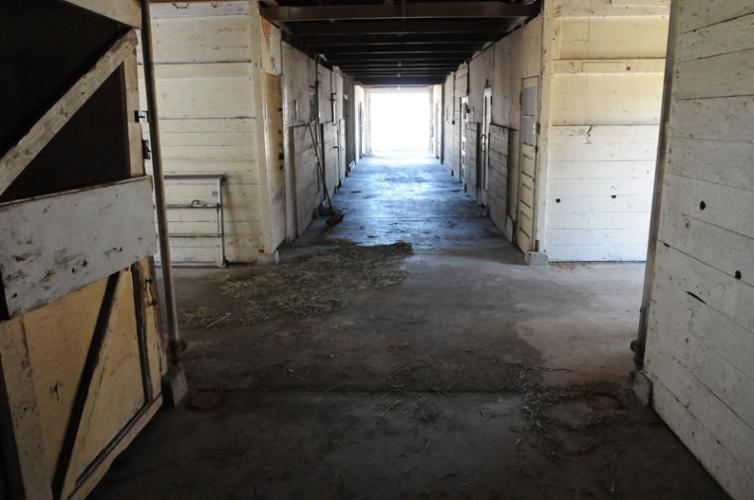
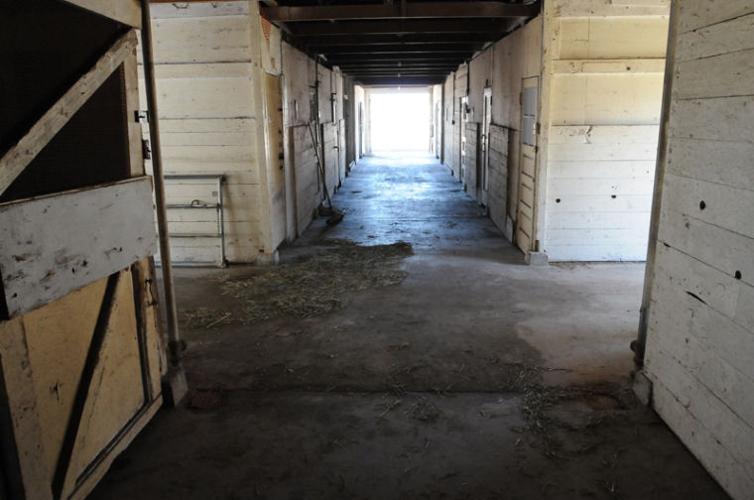
In the lead-up to WWII a vet hospital was built on the grounds along with blacksmith and harness shops for each of the 21 newly built stables, along with large corrals. Krenzelok, who has studied the Army Veterinary Corps closely, says some 1,400 horses lived at Fort Ord.
Leaders anticipated that the horses would come in handy in battles that might reach American soil: As Walter J. Schweitzer, 107th Cavalry Stationed at Fort Ord 1942, writes in a letter home, “For a short time after the Japanese struck Pearl Harbor, fear and panic struck those living on the West Coast. Many thought that they would be next to be invaded.”
“THESE MERIT PRESERVATION IN WITNESS OF AN ANCIENT ALLIANCE.”
On the morning of Dec. 7, 1941 the U.S. entered WWII, but not as expected. Soldiers stationed at Fort Ord were deployed to the Pacific to fight overseas, leaving behind the horses.
The 107th Calvary, in preparation for a coastal battle, moved to Fort Ord to care for the abandoned horses and to protect the California coastline from attack by Japanese submarines. Soldiers and horses patrolled the coastline from December 1941 until 1943, looking out for submarines that would never come. This patrolling of the coastline would be the final task of warhorses and the last time the U.S. Army and horses would work together to protect American land. The warhorse hospital closed in “a relationship that ended abruptly,” says Krenzelok, “as modern weaponry and transportation finally outmatched the horse.”
But what happened to the horses? “We went to Bay Meadows [Racetrack] where the horses were to be turned in,” says Teddy Nielson, a trained horse-drawn field artillery trooper at Fort Ord. “We cared for the horses and got them ready for sale, a veterinarian checked the horses out. We were told the horses would be sold to the movie industry or turned over to the Coast Guard.”
With CSUMB planning to tear down Fort Ord’s 12 remaining stables, FFOW efforts to preserve these buildings are growing urgent. FFOW has formed a steering committee to discuss a plan of action for the creation of the museum. Volunteer curators would conduct tours of the stables outfitted with horse-drawn articles of war such as saddle and gun holsters and horse-drawn artillery units, and hospitals where the equines were examined. The dream result: a complete look at what it was like at a U.S. Army veterinary hospital in 1941.
“These landmark buildings merit preservation in witness of an ancient alliance,” Krenzelok says.
And, since every military museum can benefit from a little reenactment action, FFOW envisions old military strategy being staged on the grounds. Visitors would learn about the unique role of horses in battle and ways the warhorse contributed that machines couldn’t – covering land that tanks couldn’t, performing reconnaissance in a stealthier manner, and, as Karen McMannon, daughter of veteran Walter J. Schweitzer, says, behaving more gently.
“His horse never threw dad,” she says, “but his motorcycle did after the 107th became mechanized.”
(0) comments
Welcome to the discussion.
Log In
Keep it Clean. Please avoid obscene, vulgar, lewd, racist or sexually-oriented language.
PLEASE TURN OFF YOUR CAPS LOCK.
Don't Threaten. Threats of harming another person will not be tolerated.
Be Truthful. Don't knowingly lie about anyone or anything.
Be Nice. No racism, sexism or any sort of -ism that is degrading to another person.
Be Proactive. Use the 'Report' link on each comment to let us know of abusive posts.
Share with Us. We'd love to hear eyewitness accounts, the history behind an article.