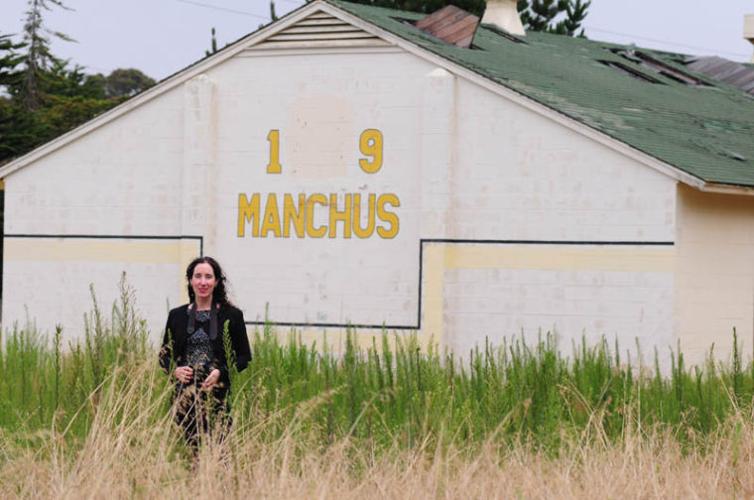
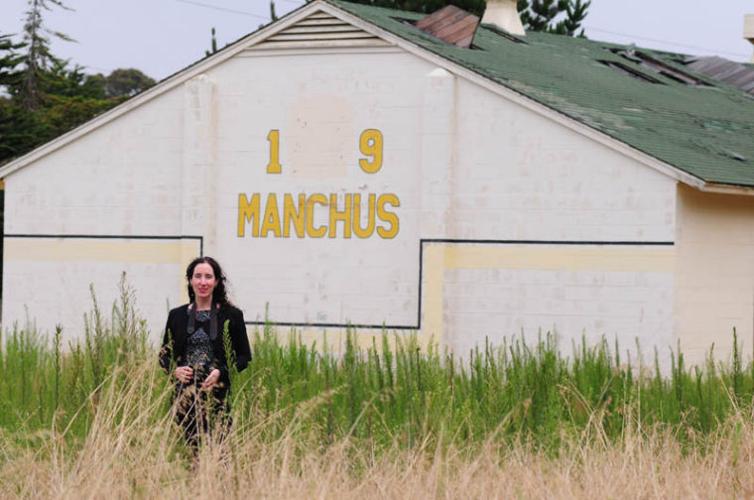
Enid Baxter Blader and a handful of intrepid CSU Monterey Bay students enter an abandoned barrack on the former Fort Ord. Their weapons of choice are cameras and adrenaline. Their targets are ghosts.
And while no Scooby-Doo-esque specters jump out at them, spirits are everywhere in these buildings: in the dusty rooms, drooping cots, shattered windows, orphaned papers and letters – and especially in the 583 murals that sprawl across the walls and hallways.
Blader, a professor in experimental film and chair of Teledramatic Arts and Technology at CSUMB, has spent more than a year exploring the abandoned base, documenting the buildings, art and miscellaneous traces that 60 years of soldiers and families left behind.
The project, once called Fort Ording, is now titled Planet Ord, inspired in part by the area’s otherworldliness. Its goal is simple, even if its completion will be complex: understand the fort’s history by immortalizing the buildings and community memories.
The indoor murals are particularly striking. Some are regiment insignias, but many others peek into soldiers’ minds, hundreds of expressions preserved in time and paint – men crouched in jungles, tanks and choppers, eagles, flags, and girls in bikinis on motorcycles.
“When we stepped inside, I felt overwhelmed,” says Nick Kova, a photographer and former student. “We quickly realized how much potential there was.”
That potential produced thousands of pictures, hours of videos and interviews, and an outpouring of community support, resulting in a website – with now almost 1 million hits – full of content Blader is turning into a series of documentaries and, eventually, a book.
Since the base’s closing in 1993, the buildings have been left at a standstill, with some systematic demolitions as the land is repurposed for CSUMB or housing developments. To Blader, the encroaching erasure instilled urgency.
“I felt this incredible anxiety that the buildings hadn’t been documented,” she says. Her enthusiasm for historical preservation, she says, comes from her home, a Revolutionary War reenactment town in eastern Pennsylvania.
When she joined CSUMB’s faculty in 2006, Blader felt drawn to the history and eerie presence of the fort. In 2009, she took her advanced video students on bicycle into the fort, encouraging exploration – and eventually asked some of these students to join her project once the class had ended.
“I told them, ‘You guys are going to college in a ghost town! No one else gets to do that,’” she says. “A lot of soldiers here were drafted, eligible for the draft because they weren’t in college. Now the fort is a college campus – what a change.”
Kova estimates that 60 to 70 percent of the site’s photos are his.
“It’s very real to see photos and video of the bases from years ago,” he says. “You look at how the place was built – I mean, some foundations were laid by prisoners of war. You realize that people were held here against their will.
“The oddest question I was ever asked by a reporter was, ‘Did exploring the base make you want to enlist?’” Kova continues. “It didn’t really – but it changed the way I thought about soldiers. Every time you take pictures of their paintings, you see through their eyes. It humanizes them.”
The fort’s alumni have plans for further collaboration with Blader.
“We’re more than pleased that [Blader] is taking these pictures – it gives a totally different perspective to non-military people of soldiers’ lives,” says Colonel Bob Furney, a board member of the alumni association. “We’re not all just gung-ho; we have a softer side.”
To Doug McCulloh, who documents the now-closed El Toro air base in Orange County, the closing of a base creates unique artistic opportunities.
“These bases were central parts of communities and U.S. power, then they were suddenly ghost towns,” he says. “Cameras capture something before it’s gone. There’s a human presence even with half an inch of dust on the floor.”
Blader’s favorite feedback comes from former residents.
“I’m just trying to get the community to share their memories of Fort Ord,” she says.
Although the project will eventually expand from its current state – website, blog, short films – into a feature film and possible print publication, Blader says she won’t be finished once that’s accomplished.
“It’s never going to end,” she says. “I’m always so excited to talk about soldier art, and there are so many other aspects to explore. I look at the [Base Realignment and Closure] lists and I just want to visit them all.”
(0) comments
Welcome to the discussion.
Log In
Keep it Clean. Please avoid obscene, vulgar, lewd, racist or sexually-oriented language.
PLEASE TURN OFF YOUR CAPS LOCK.
Don't Threaten. Threats of harming another person will not be tolerated.
Be Truthful. Don't knowingly lie about anyone or anything.
Be Nice. No racism, sexism or any sort of -ism that is degrading to another person.
Be Proactive. Use the 'Report' link on each comment to let us know of abusive posts.
Share with Us. We'd love to hear eyewitness accounts, the history behind an article.