At first sight shoppers see a doggie in the window, complete with the waggly tail.
That is, if they have 20/10 vision – the collie is tiny enough to fit in a tablespoon.
A second eagle-eye glance uncovers other teeny and textured details: Holstein cows grazing along a fence, a milking stool placed nearby. Hens picking around the carrots in the yard and pigs exploring the cabbage rows. Furry goats peeking through the fence boards as a cat bats at a blue butterfly. Then there’s the house with a straw roof and fruit pies cooling on the windowsill.
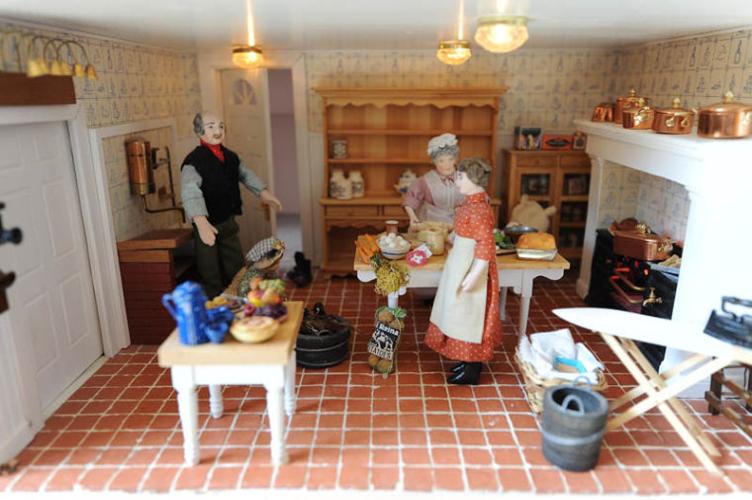
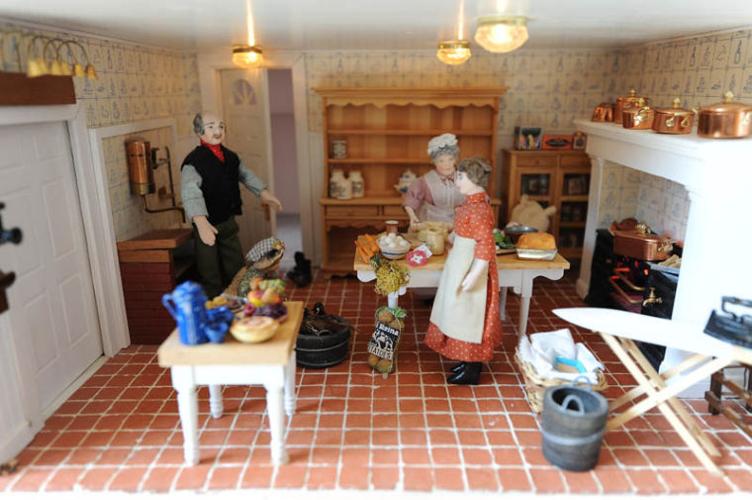
The sweeping farm is incredibly detailed – as are the shops, pubs and inns across town – but farm’s acres might only cover a coffee table. Such is the scale at the Barnyard’s Smallsea: A Metropolis in Miniature, a fictional city based on the life of London in the early 1900s.
Carmel’s Diane Birnberg is its author and creator, and a former finance-interior design professional. She says her obsession started with one dollhouse her husband bought her before it grew into a full-time hobby and a project that’s now going on 15 years.
“I have a fascination with the small and sometimes minute representations of life,” she says.
But it takes more than a love of the little to collect memorabilia piece by piece, to attend at least two miniature conventions in two countries every year, and to dedicate as many as 30 hours a week to wallpapering elaborate dollhouses and wiring them for electricity.
“Well, I am retired,” she concedes, though she still travels to Chicago regularly to direct a niche business that manages liquid assets for hedge funds.
“It’s like being a writer,” she continues. “Making up a story and then making it come to life. The creativity is in the whole concept. What’s around the butcher shop? Who’s shopping there?”
For a self-admitted perfectionist and lover of the Edwardian era, precise details are crucial. The prices on the mini-meats are in pounds and pence, there is no plastic packaging and only rudimentary refrigeration, and sawdust on the floor catches juices. She loves it when someone identifies a tiny out-of-place detail – like a cigarette the size of a grain of rice in one of the two pubs (one by the dock for the scallywag set, another uptown). A patron pointed out it had a filter; in the Edwardian era only non-filtered cigarettes existed.
“It’s crazy but people, once they get into it, they really look,” she says. “I love that someone paid that much attention.”
She finds figures in catalogs and online (check out www.imaginationmall.com); some she accumulates at miniatures fairs as close as San Jose and as far away as Birmingham, England. It has become what her husband – who doubles as her chief contractor, erecting the small structures before she appoints them – describes as a “worldwide hobby.” An elevator came from England, their little printing press was discovered in Chicago, and the scientist in the lab is inspired by Albert Einstein.
Birnberg acknowledges the mini venture isn’t making big money. “We’re not in the business of business,” she says. “It’s hard to do this type of thing without sharing it with people.”
At present, they have 36 buildings. Further development is planned: a perfume shop, taxidermy, newspaper and school are on Birnberg’s mind. A “Miniatures Club” is in the making and kits for building mini-homes will be available closer to Christmas. Sidewalk sales showcasing furniture, accessories, and dolls also await. One little girl has even celebrated her birthday with a tea party in the middle of the village.
“To my knowledge,” Birnberg says, “there’s nothing like a whole city anywhere else in the [United] States.”
On a recent afternoon she was putting together Howard’s Bon Marche Department store, a three-story building complete with a grand staircase, chandelier, and black and white tile flooring. The luggage department has glass display cases filled with leather gloves in two colors, briefcases and trunks, and baskets stuffed with umbrellas and canes. Using tweezers and museum wax, Birnberg turns an ordinary chest of drawers into one specifically designed for organizing the fabric department.
Over several days, the “structure comes to life” as she has envisioned it.
She is quick to add a note about the wider metropolis’ evolution, though.
“The display is never finished,” she says. “I am always collecting.”
(0) comments
Welcome to the discussion.
Log In
Keep it Clean. Please avoid obscene, vulgar, lewd, racist or sexually-oriented language.
PLEASE TURN OFF YOUR CAPS LOCK.
Don't Threaten. Threats of harming another person will not be tolerated.
Be Truthful. Don't knowingly lie about anyone or anything.
Be Nice. No racism, sexism or any sort of -ism that is degrading to another person.
Be Proactive. Use the 'Report' link on each comment to let us know of abusive posts.
Share with Us. We'd love to hear eyewitness accounts, the history behind an article.