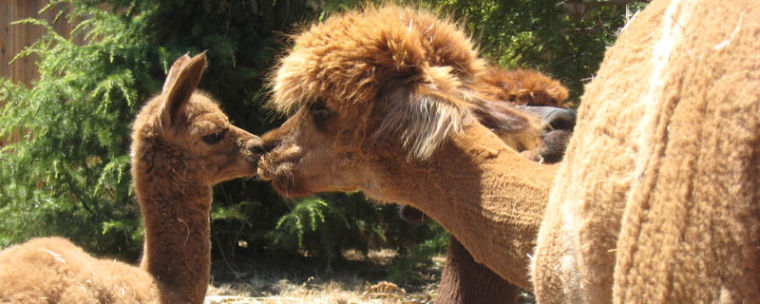
Nancy Baker awoke on a recent Saturday morning to a sight that made her breathe a sigh of relief. Galaxy, a then-yet-to-be-born cria – or baby alpaca – was about two weeks overdue, and Baker had been a little concerned.
“I walked outside and he was just standing there with about 10 feet of umbilical cord,” Baker says.
Galaxy was born on July 17. He’s already 2 feet tall with curly blonde fur and dark, soulful eyes.
Two weeks after his birth, the cria’s mother, Sequoia, is still intensely protective of her baby, even towards her own daughter, Michelle. The shy animals are skittish when approached, so Nancy enlists the help of her fifth-grade daughter, Grace.
“My daughter is like a Native American,” Nancy laughs. “She can creep right up to them.”
Grace comes out to the corral and watches the llamas. She says she must approach the animals very cautiously and that they may run away. “The only one I can even get close to is Michelle,” she predicts. Grace creeps up to Michelle, hunched over to appear more alpaca-like; Michelle bolts. “OK, I get the point,” Grace says.
Baker says it’s a common misconception that alpacas spit all the time – they only do it when agitated. “We had a preschool class come and one little boy kept asking, ‘Is she gonna spit now?’” She added that if anyone tried to approach Galaxy, Sequoia would definitely spit. “It’s very smelly.”
As Grace creeps over to the mother and son, Sequoia is cautious, but Galaxy is fascinated, edging away to investigate the child. Nancy says in time Sequoia will likely be less protective of her cria. “Galaxy really loves [Grace],” she says. “He just doesn’t know how to get close to her.”
Baker bought the alpacas at the Del Mar Fair in San Diego a year and a half ago, after her daughter saw the camelids during a farm day at the Monterey Fairgrounds. She says the animals, relatives of the llama, camel, and vicuña, make great pets because they take up less space than other farm animals and are clean and gentle. “I could leave Grace out here and I don’t have to worry at all,” she says.
Alpacas are very social and curious, which Grace says has become more apparent since the new birth. “Now that the mom has had another baby, Michelle has had more freedom so she acts in a totally different way.” The young female uses her newfound freedom to climb dirt piles and venture to the fence to greet her owner and gaze at her unfamiliar companion with inquisitive eyes.
~ ~ ~
Vicki and Dennis Rabe, who own 101 Alpacas ranch in Prunedale, have been helping Baker as she begins her own herd. The Rabes’ ranch is home to 30 alpacas, of which about half are theirs. (They agist, or board, other alpacas for people who do not have the space.) Because alpacas are herd animals, Rabe recommends that owners keep at least two together, and says some ranches house herds of up to 1,500 animals. There are relatively few alpaca ranches in the area, so Baker says owners keep in touch and help each other out. Rabe advised Baker during Sequoia’s pregnancy, providing tips on feed, breeding options, and where to sell the shorn alpaca fiber for processing.
Alpacas are shorn once a year, averaging 1 to 1.5 pounds of fleece for younger animals and 3 to 5 pounds for adults. Rabe says that high-quality fleece taken from the animal’s belly, shoulders and flank is longer and the best quality. It can sell for up to $45 per pound, although value diminishes when the animal gets older because its regularly soft fleece becomes coarser.
“We have some folks that do that for an investment and then sell the offspring,” she adds. “That’s how they build up an investment or pay college for the kids.” After the animal is sheared, the wool must be washed and carded, a process that untangles the hairs so they can be woven into yarn.
As she grows her herd, Nancy is unsure whether Galaxy will be a herd sire, or gelded and used only for fiber. She hopes to breed each female alpaca to complete the herd. “We’ll probably have a few more, but because of space we’ll keep it around five.”
The gamboling, noisy animals can be lucrative, but Baker says she bought them for their endearing nature. “I’m working on their people-friendliness so people can learn about them,” she says. “You kind of fall in love with them.”
(0) comments
Welcome to the discussion.
Log In
Keep it Clean. Please avoid obscene, vulgar, lewd, racist or sexually-oriented language.
PLEASE TURN OFF YOUR CAPS LOCK.
Don't Threaten. Threats of harming another person will not be tolerated.
Be Truthful. Don't knowingly lie about anyone or anything.
Be Nice. No racism, sexism or any sort of -ism that is degrading to another person.
Be Proactive. Use the 'Report' link on each comment to let us know of abusive posts.
Share with Us. We'd love to hear eyewitness accounts, the history behind an article.