If Benjamin Franklin had gotten his way back in 1784– when he fired off a resolute dispatch from his diplomatic post in France to his daughter Sally back in Philly, complaining vociferously against the choice of bald eagle as the national bird, calling it a “rank coward” of “bad moral character”– we might be a country of turkeys. Instead of the majestic, freedom-screaming icon that Americans proudly look up to for anthropomorphized glory, Franklin’s true “bird of courage” was the mighty wild turkey with its red-necked gobble. And instead of spending a consciously gorgeous January day aboard the sturdy decks of the Monterey Parks Department flagship, Eagle 1, cruising the refreshing waters of Lake San Antonio searching for Bald Eagles, I might be mucking through some Eastern swampland, chasing wild turkeys.
Thankfully, Franklin gave up that fight in the name of democratic concession, and the bald eagle was named our national bird after six years of debate, and then protected over the intervening centuries in a series of national proclamations which sought to preserve its rightful place in the wild. And if ever there is a place to see a bald eagle, it’s right here in the mashed potato hills of southern Monterey County– where flocks of balds, goldens, Canada geese, swans and countless other winged relatives migrate for a little mid-winter respite from the harsh climes and iced-over hunting grounds of northern living.
Lake San Antonio has been eagle-centric long before it was officially a lake, having hosted bald eagles nesting and hunting along the feeder-stream, the San Antonio River, for ages. In 1984, the Monterey Parks Department took notice of their rising tourism business and sanctioned the building of Eagle 1, a flat-decked, cabriolet-styled observation platform outfitted with rows of comfortable pews and a few powerful outboards to ferry the curious tourists and serious birders alike around the raptor-habitated shores.
A recent Saturday crowd boards the vessel after viewing an aged introductory eagle documentary in the rumpus room of the well-stocked lodge. Our tour guide, Amy Sweet, makes sure all of the young children have life preservers, and that anyone who wants them have binoculars. “Everyone get your eagle eyes out!” she says.
Within minutes, a raptor sitting low in the yawning branches of a lakeside oak tree is spotted from the bow. The drama is palatable as coordinates are roughed in and focus gained. “It’s an immature bald eagle!” Sweet explains. “See the mottled feathers? When it matures, its head will turn stark white.”
She guides those who don’t see the camouflaged bird with practiced skill. “See the downed limb on the bank? Look straight up from that snag, and to the right. It’s sitting on the right leaning branch.” A chorus of approval filters through the crowd as the target icon is acquired. While difficult to discern, once spotted, the bird is unmistakably large and beauteous.
A strong January sun steams through the unbridled sky, and the tour skirts the substantial girth of Lake San Antonio while a watchful assembly scans the surrounding tree line. We spot several more immature bald eagles along with a host of geese, bobbing grebes, American coots, red-tailed hawks, swans, deer, coyotes, and someone’s wife, who waves excitedly back from an adjacent campsite.
Circumnavigating the lake, our group takes on a familial manner. Strangers share histories over snacks and point out the abundant wildlife to one another. Boy Scout Troop 194 from Bakersfield constitutes a good third of the passenger list. They are working on a bird study merit badge, a project that is happening after two years of planning.
“A lot of the good that our taxpayers do is to set aside resources and protect our wildlife,” says Assistant Scout Leader Richard Kemp. “These eagles are our national identity. What would it mean if they were now longer wild? What an opportunity to see America’s symbol of strength and courage in its element!”
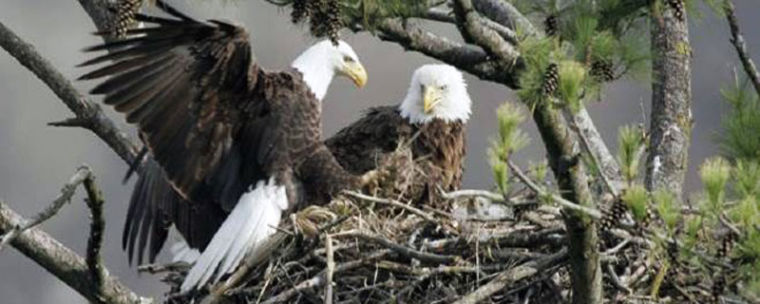
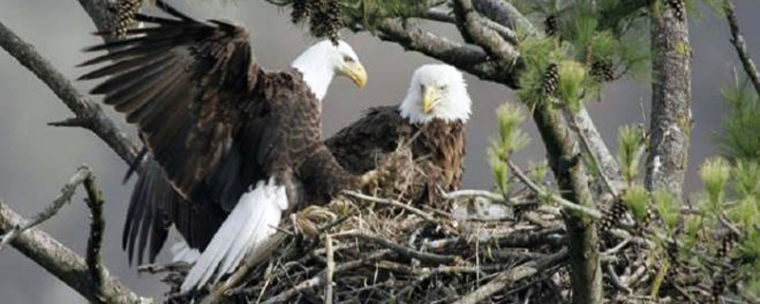
As if on queue, Sweet alerts the group to an inestimable sight: Two mature bald eagles poised perfectly on a branch in plain view just a few dozen yards away. The birds are huge and shockingly beautiful. Their appearance near the end of our journey around Lake San Antonio is a joy-inducing gift.
“God bless America!” shouts Tom Durkee, a Vietnam Vet from Los Osos. “This means a lot to me… ” he says, trailing off in thought. Shutters fly and memories form.
A young boy on board named Isaac Urquiz, no more than 10 years old, developed an attachment to the bald eagle since “before I learned to say the word.” His mother says that his bedroom is plastered with eagle paraphernalia, and as we pull into the home slip at the boat launch, Isaac’s glee is rampant. “That was so cool.” he gushes. “Really cool! Those bald eagles are America.”
EAGLE WATCH tours take place 11am-2pm on Feb. 7 and 21 on Lake San Antonio in Bradley, south down Highway 101. (888)588-2267, www.co.monterey.ca.us/parks/sanantonio_ss_tours.html. $12/adult; $10/children 6-12, seniors. Bring a lunch, water and dress for inclement weather. (Tours operate rain or shine).
(0) comments
Welcome to the discussion.
Log In
Keep it Clean. Please avoid obscene, vulgar, lewd, racist or sexually-oriented language.
PLEASE TURN OFF YOUR CAPS LOCK.
Don't Threaten. Threats of harming another person will not be tolerated.
Be Truthful. Don't knowingly lie about anyone or anything.
Be Nice. No racism, sexism or any sort of -ism that is degrading to another person.
Be Proactive. Use the 'Report' link on each comment to let us know of abusive posts.
Share with Us. We'd love to hear eyewitness accounts, the history behind an article.