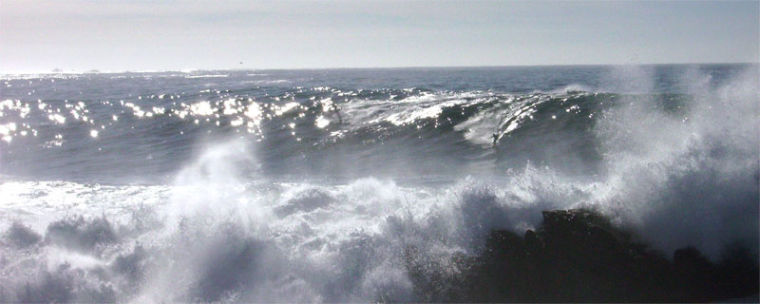
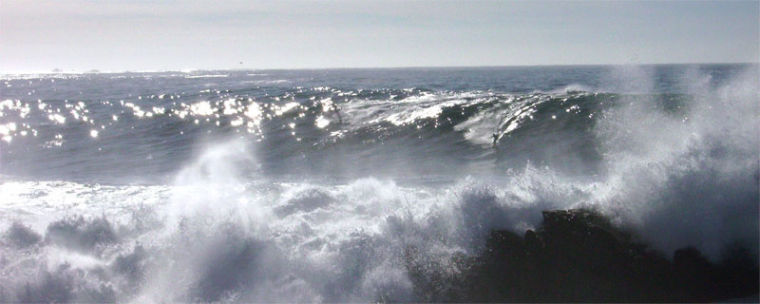
The end of the Ghost Tree era was as inevitable as the tide. When the draft plan for the Monterey Bay National Marine Sanctuary was generated back in 2006, the tow-surfing community knew it was only a matter of time before the repercussions finally hit shore and closed down Ghost Tree to personal water craft, or PWCs.
Released to the public last week, the final plan definitively bans PWC use in all areas of the sanctuary beginning in early 2009. The only exceptions are four pre-existing zones near boat harbors, as well as a seasonal fifth zone designated specifically for tow-in surfing at Mavericks in Half Moon Bay. According to the plan, Mavericks will be considered a seasonal zone allowing PWC use, but will only exist during periods of “High Surf Warning” issued by the National Weather Service, and only during the months of December, January and February.
So is it an end of an era? Definitely. Is anyone really surprised? No. Is it the right thing to do? I don’t know. Most of the high-profile tow surfers I’ve talked to lament the ruling. They argue that the wave, which breaks off Pescadero Point in Pebble Beach at heights of up to 70 feet, goes off so infrequently that their sport’s impact has always been minimal. They argue that their PWCs are the cleanest machines in the ocean. They argue that the ban will not end tow surfing at Ghost Tree, but only make the whole dangerous enterprise exponentially sketchier.
It’s hard to argue with any of these points. However, the Monterey Bay National Marine Sanctuary existed before the sport of tow surfing and from an objective point of view, it was the right decision. NOAA is just trying to be consistent. The final plan points out that restrictions on PWC use have already been applied in nearby areas such as the Gulf of the Farallones National Marine Sanctuary, Golden Gate National Recreation Area and Marin County. Furthermore, tow surfing was really never supposed to happen in the sanctuary at all. The original 1992 plan, which banned jet skis in most of the sanctuary, neglected to specify multi-seat jet skis, creating a loophole in the ruling that tow surfers have been exploiting for years.
Then again, tow surfers are justified in feeling singled out. There was no real impact study done and far “dirtier” vessels than PWCs will still be allowed to chug through the sanctuary year-round.
I’ve watched this entire story unfold from the beginning. In fact, in some ways, I’m as much responsible for the hype and spindrift surrounding Ghost Tree as anyone. It’s the one story I’ve always regretted writing. About four years ago I exposed the wave to the world with a big glossy article in Surfer’s Journal, a cover story for Surfer Magazine and then a series of articles in this newspaper. To be honest, if I could take it all back, I probably would. As a result, I feel a certain amount of relief that the ban is finally being put in place.
Trust me, I’ve already paid for my decision. I received death threats on my voicemail at the Weekly, spent years defending my decision to the surf community and even got into a few fights in the water. Realistically, I know that if I hadn’t broken the story, someone else would have. It was only a matter of time. You can’t hide a 60-foot wave. But that doesn’t change the fact that it was me who broke it.
When Peter Davi died last December at Ghost Tree, I felt nauseous with regret over the tragedy. I didn’t suit him up and put the board in his hands, but I helped create the circus of helicopters, photographers and media that buzzed around Pescadero Point that day, oblivious to his body floating just a few hundred yards away.
All that said, the Ghost Tree story is far from over. Anyone who thinks that a $500 fine is going to stop the pros from trying to score a spot on the Billabong XXL stage is just naïve. I’ve already heard surfers talking about retrofitting their jet skis with propellers or towing in behind zodiac boats. I’ve heard others say they’ll simply ignore the new law. Whatever happens, policing Ghost Tree will be difficult.
Moreover, there will be other effects. Mavericks, which has already become dangerously crowded on big days, will be an absolute zoo. And without a place to practice towing in smaller, safer waves, there will be a much steeper learning curve for newcomers, which puts everyone else in more danger. In addition, other surfing communities outside of the sanctuary will probably start seeing a lot more tow surfers in their line-ups.
So here are my last words on the subject: I hope in the wake of this new ruling, Ghost Tree goes back to being Pescadero Point and the guys who were out there catching waves simply for the sake of catching waves reclaim the place – hopefully, without a photographer or a reporter in sight.
(0) comments
Welcome to the discussion.
Log In
Keep it Clean. Please avoid obscene, vulgar, lewd, racist or sexually-oriented language.
PLEASE TURN OFF YOUR CAPS LOCK.
Don't Threaten. Threats of harming another person will not be tolerated.
Be Truthful. Don't knowingly lie about anyone or anything.
Be Nice. No racism, sexism or any sort of -ism that is degrading to another person.
Be Proactive. Use the 'Report' link on each comment to let us know of abusive posts.
Share with Us. We'd love to hear eyewitness accounts, the history behind an article.