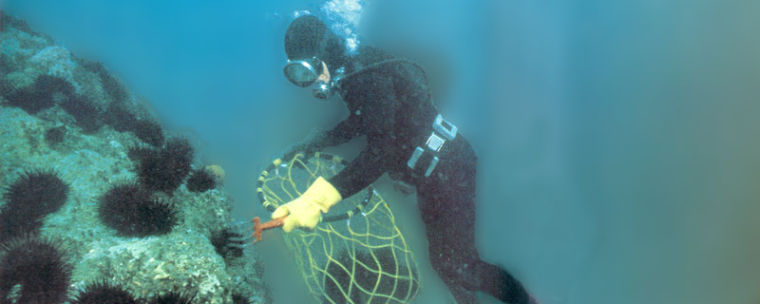
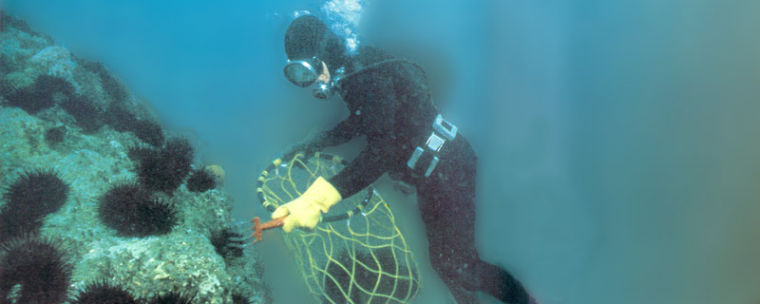
Tom Kendrick was 30 feet underwater off the Farallon Islands looking for sea urchins when a 12-foot white shark suddenly blasted through a curtain of murky water toward him . A long-time sea urchin diver, Kendrick had encountered a dozen great whites during his 100+ trips to the Farallones, a lonesome spine of rock jutting out of the Pacific 27 miles from land. But the other sharks had moved slowly and deliberately; this one flew at him like a giant gray torpedo.
With poor water visibility that day, the shark quickly disappeared into the murk. Kendrick’s heart felt like it stopped and he held his urchin basket, a wire net container the size of a trash can, in front of him like a feeble shield. Then the shark ripped through the clouded water again before quickly disappearing. He wondered if there was more than one shark lunging by him.
After several more nerve-rattling encounters, the shark was finally out of Kendrick’s field of vision. He waited a few minutes and then began to surface. “That was probably the most scared I’ve ever been,” Kendrick says. “That was one of my worst moments, and that ended my diving on the Farallones.”
A sea urchin diver off the coast of California from 1978 to 2000, Kendrick recalls many of his adventures in his new book, Bluewater Gold Rush: The Odyssey of a California Sea Urchin Diver. He says it was his love of surfing that got him interested in maritime pursuits like boating and urchin diving.
Kendrick spent his first nine years as an urchin diver plucking the spiky sea creatures off the coastal floor and unusual underwater rock formations by the Channel Islands. His book details a cast of colorful characters from the Santa Barbara urchin diving community, including a profanity-spewing diver named Crazy Harold and a former pot smuggler-turned-urchin diver named Jim Cotton.
Kendrick also describes the cutthroat practices of the urchin diving industry. “An urchin diver told me, ‘Tom, this is a knife-in-the-back business, and if you are going to be successful, you better have a big knife,’” Kendrick says.
But competition was usually the least of his worries. There was the treacherous 30 miles of open water between Santa Barbara and the Channel Islands that could be overrun by giant waves that Kendrick refers to as “white buffaloes” and the dangers inherent in scuba diving, including decompression sickness, which can cause paralysis or death. And there were the dangerous ocean animals to contend with, from sharks to the urchin themselves, which have needle-like spines.
“I had [an urchin needle] go really deeply into my Achilles’ heel,” he says. “The pain is so bad you almost pass out.”
Despite the risks, the payoffs became greater and greater from the time Kendrick began diving in the ’70s; the industry peak came in the late ’80s and early ’90s. Kendrick was taking home a respectable $100 a day when he began. Then the Japanese started to develop an insatiable appetite for uni, the edible gonads of the urchin, and Kendrick was frequently making more than $1,000 a day. His best day of diving yielded $12,000.
In 1987 he moved from Santa Barbara to the Northern California community of Point Arena to tap into that area’s burgeoning sea urchin industry. A couple years later, he began venturing out to the Farallon Islands, an almost untouched underwater environment– due in no small part to the islands’ notorious white shark population.
“It’s a completely different atmosphere out there,” Kendrick says of the Farallones. “It’s a little spookier.”
Though Kendrick’s great white experience ended his urchin diving trips to the Farallones, he kept hunting for a few more years until a string of tragedies hit. First, one of Kendrick’s best urchin diving buddies was killed by a shark while diving off the Channel Islands. Then, as Kendrick was on the deck of his boat after an urchin dive off San Clemente Island, his hand suddenly went numb. He realized he was suffering from decompression sickness. Though he was cured after three treatments in a Long Beach decompression chamber, he decided that it was finally time to start getting out of the business.
Even though Kendrick is now trying to make Bluewater Gold Rush into a feature film (and also runs a property management company in Northern California), there’s one aspect of urchin diving he wishes was still part of his life. “Every day,” he says, “I miss the camaraderie of all the guys.”
(0) comments
Welcome to the discussion.
Log In
Keep it Clean. Please avoid obscene, vulgar, lewd, racist or sexually-oriented language.
PLEASE TURN OFF YOUR CAPS LOCK.
Don't Threaten. Threats of harming another person will not be tolerated.
Be Truthful. Don't knowingly lie about anyone or anything.
Be Nice. No racism, sexism or any sort of -ism that is degrading to another person.
Be Proactive. Use the 'Report' link on each comment to let us know of abusive posts.
Share with Us. We'd love to hear eyewitness accounts, the history behind an article.