Sharks, he says, are the least of our concerns. There are lots more likely ways to die while scuba diving.
If you ascend to the surface too fast, for example, your lungs could burst. (The way down brings the slightly less hazardous risk of a busted eardrum.) Then there’s decompression sickness, aka “the bends,” caused by the formation of gas bubbles in your tissues while ascending– which can only be treated inside the nearest recompression chamber. Narcosis happens when nitrogen gas under pressure imparts an intoxicating nervous effect akin to laughing gas, inspiring divers do stupidly dangerous things. And of course there’s the old-fashioned risk of drowning on an empty oxygen tank.
But if you know how to dive right, explains Ron Stevens, owner of The Monterey Dive Center, scuba diving is actually quite safe and fun.
Sufficiently rattled, my classmates and I pay careful attention during the academic segment of the Open Water Diver class, which we are taking to become certified scuba divers through the Professional Association of Diving Instructors.
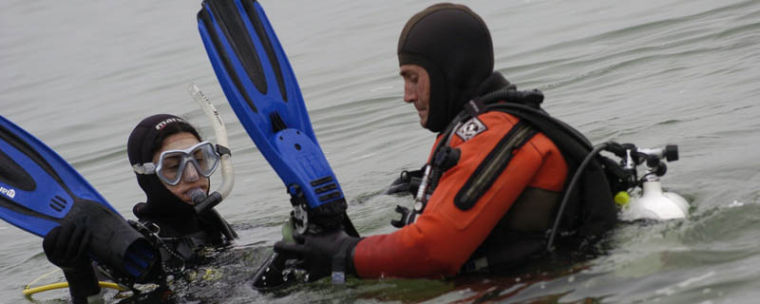
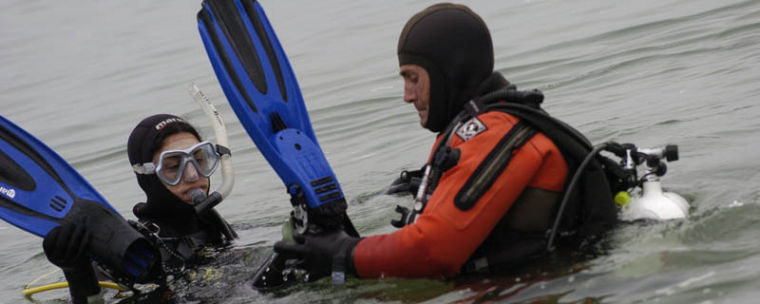
The two three-hour classroom sessions involve hokey instructional videos, reviews by Stevens, homework reading and a final exam. After that we spend five hours in the on-site pool, where Dive Instructor Lonny Lundsten and Divemaster Candidate Scott Dierks familiarize us with the equipment and basic diving skills.
The 12-foot-deep, bromine-sanitized tub is the only on-site heated scuba training pool in the Monterey Bay area. Stevens is proud of his pool, but it’s been giving him trouble: oxidizing paint has been clouding the water with milky bubbles. A few days after our session he has the pool drained, sandblasted and repainted.
In the turbulent world of scuba, where low-visibility ocean conditions or a simple case of congestion can cancel a dive, it’s important to be flexible. The same rule holds for this class. The number of students fluxes from three to five, and a scheduling conflict forces us to do one marathon pool session instead of two shorter ones. We learn how to assemble and fit our gear, then lub into the pool and practice basic scuba skills like gesturing underwater, clearing a flooded mask, replacing a knocked-out regulator and sharing air.
Because my classmates learn at a different pace, my first “open water” excursion is a private ocean dive with Lundsten.
Putting on more than 50 pounds of equipment is the worst part. The wetsuit encases my body in a cocoon of neoprene, tight and uncompromising. The mask squeezes the skin on my forehead and covers my nose, snorkel dangling at one end like an off-center antenna. Booties, gloves and hood complete my transformation into a sea mammal. I feel preposterous standing at the Lovers Point parking lot among humans in tank tops and flip-flops.
Finally I heave on the buoyancy control device, which is stuffed with lead weights, clipped into the tentacled regulator and strapped onto the air tank. Fins in hand, struggling to stay upright, I follow Lundsten down the steps to the beach.
As we wade into the bay dressed like intergalactic seals, the ocean recognizes us as its own. The cold gray water buoys us up, taking the weight off our backs. We swim about 50 yards, then sink 35 feet, breathing slowly and deeply from our regulators and blowing into pinched nostrils to equalize our ears. Using the underwater charades we practiced in class, Lundsten instructs me to demonstrate skills like the “fin pivot” to establish neutral buoyancy and the controlled emergency ascent. Then it’s time for a tour of the ocean floor.
As a deep-sea marine biologist and video analyst with the Monterey Bay Aquarium Research Institute, Lundsten is a magnificent guide. He points out velvety gumboot chitons, otherworldly lightbulb tunicates, purple and gold turban snails, orange puffball sponges and spider crabs. He also finds a single ankle sock, finally answering that age-old question of where all my lonely socks’ mates have gone.
The macrocystis kelp I’d seen hundreds of times from the beach look different down here. Anchored by holdfasts to rocks on the sandy ocean floor, they are ethereal trees swaying in the current. Perch and rockfish dart between their stipes. A leafy purple kelp called Turkish towel clings to the gray rocks, obscuring the sea stars and anemones snuggled underneath. Sunlight filters through plankton and silt, turning our world a cloudy green.
Surprisingly, the fears that I grappled with in the classroom are gone. I’m confident in the equipment, in my instructor and in myself. The payoff is not so much the novelty of breathing underwater; it’s the alien perspective of being in an ecosystem where humans do not belong.
Back in the parking lot, once I’ve shed the gear and the wetsuit, my lungs feel bigger, more powerful. Visions of chitons and tunicates sway in my memory. And I’m happy to be a land mammal again.
Route System
THE MONTEREY DIVE CENTER
(0) comments
Welcome to the discussion.
Log In
Keep it Clean. Please avoid obscene, vulgar, lewd, racist or sexually-oriented language.
PLEASE TURN OFF YOUR CAPS LOCK.
Don't Threaten. Threats of harming another person will not be tolerated.
Be Truthful. Don't knowingly lie about anyone or anything.
Be Nice. No racism, sexism or any sort of -ism that is degrading to another person.
Be Proactive. Use the 'Report' link on each comment to let us know of abusive posts.
Share with Us. We'd love to hear eyewitness accounts, the history behind an article.