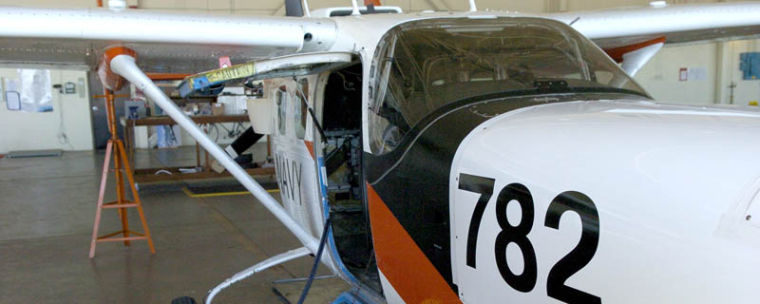
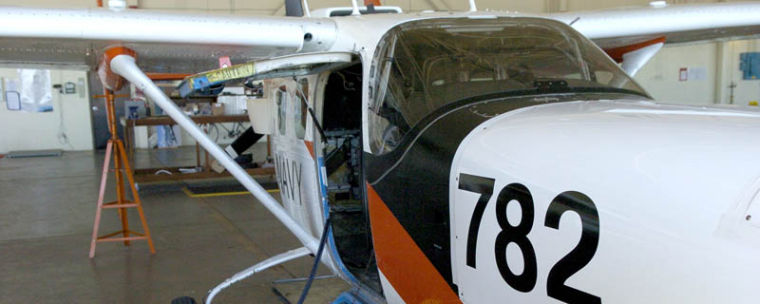
Inside nondescript hangar 507 at Marina Muncipal Airport hides a scientific armada, Naval Postgraduate School’s answer to Starfleet.
Mechanics prep Twin Otter, a dual engine plane, for its next cloud- and climate-sampling mission. Pelican, an orange and white modified Cessna 337/02-A, waits for spy plane training. A Mobile Research Radar truck just got back from chasing twisters in Kansas.
Each craft of the Center for Interdisciplinary Remotely-Piloted Aircraft Studies’ fleet was formerly used for military operations, says Bob Bluth, the center’s director: The Twin Otter came from the Alaska Air National Guard; the Pelican was foraged from an Air Force boneyard; the radar once belonged to the Army.
“We’ve been taking military equipment,” Bluth says, “and then we modify it to do science.”
During its four to six missions a year, Bluth says, the Twin Otter measures precipitation, condensation, temperature, humidity, cloud physics, solar radiation and wind. It often flies into the stratocumulus clouds on the coast of Monterey Bay. Researchers sometimes outfit Twin Otter with a smart towed vehicle that hovers 30 feet off the water to study how the ocean and atmosphere interact.
“We’re trying to improve our fundamental understanding of the environment,” Bluth says.
Roy Woods, CIRPAS research assistant, says Twin Otters’ instruments can collect particles as small as 100 nanometers or as big as raindrops. Woods is readying the aircraft for a mission that starts July 14, sponsored by the National Science Foundation. The mission will study how the changing clouds, physical properties affect the reflection of solar radiation. Woods says they are looking for “anything that hasn’t been seen before.”
Inside the plane, Woods points out a computer screen where the operator monitors all the measurements. “This is really unique because you have one operator who can sit here and see the whole operation,” he says. People observing on the ground can get live feeds of the operation thanks to satellite communication. “It’s like a flying bench lab,” Bluth adds.
CIRPAS has two study areas: atmospheric and ocean sciences plus unmanned air vehicle flight services. Since its inception in 1996, CIRPAS has collaborated with numerous universities and supported scientific expeditions across the world sponsored by institutions such as NASA and NOAA.
Bluth says CIRPAS is definitely in the top five for world-class airborne environmental research facilities.
Missing from the hangar are the center’s most intriguing aircrafts. CIRPAS maintains the Navy’s only three Predators, white upside-down spoon-shaped drones used to train the military for reconnaissance missions. The remote-controlled planes can zoom in on ground targets and relay footage back to a ground station thousands of miles away in real time. The U.S. military has used the drones to search for Osama bin Laden and to take out top al Qaeda members with Hellfire missiles. CIRPAS’ Predators are unarmed. “They are really the only dedicated research and educational Predators available,” Bluth says.
Today the Predators are out in the Mojave Desert. So Bluth shows off the next best thing: CIRPAS’ Pelican. The engine sits in the back of the plane and on the nose is a powerful camera turret equipped with video, telescope and infrared technology. For training exercises, it acts as a Predator surrogate. “From the ground station it looks like a real Predator,” Bluth says.
CIRPAS also operates the country’s only airstrip dedicated to unmanned aircraft at McMillan Airfield in Camp Roberts.
At the end of the hangar rests the large radar truck. The truck recently finished chasing about five tornadoes in Kansas and Oklahoma, studying super cell thunderstorm formation in conjunction with the University of Oklahoma.
“With the radar you don’t have to get up close and personal,” he says. “We can set up 20 miles away and collect the data.”
Back in CIRPAS’ lab, Woods talks about a Twin Otter mission later this year that will study stratocumulus clouds and the effects of pollution off the coast of Chile. “No one else does this,” Bluth says.
He adds that he recently submitted a proposal to outfit an A-10 Warthog to take into thunderstorms. Its thick armor could repel 3-inch hailstones, Bluth says. Woods pulls up a picture on Wikipedia. The gnarly war machine carries missiles and a machine gun.
“Where it had bombs on the wings, we’ll put instruments in it,” Bluth says. “Where it had a gun on the nose we’ll put a probe.”
(0) comments
Welcome to the discussion.
Log In
Keep it Clean. Please avoid obscene, vulgar, lewd, racist or sexually-oriented language.
PLEASE TURN OFF YOUR CAPS LOCK.
Don't Threaten. Threats of harming another person will not be tolerated.
Be Truthful. Don't knowingly lie about anyone or anything.
Be Nice. No racism, sexism or any sort of -ism that is degrading to another person.
Be Proactive. Use the 'Report' link on each comment to let us know of abusive posts.
Share with Us. We'd love to hear eyewitness accounts, the history behind an article.