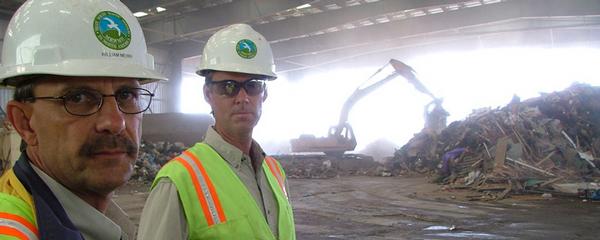
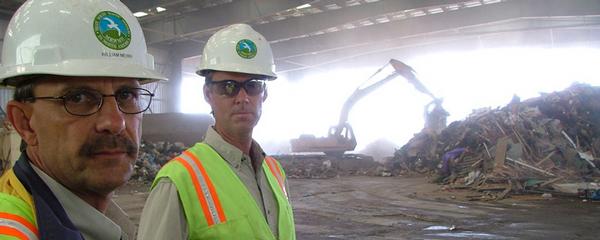
Two miles north of Marina, on 475 acres surrounded by farmland and pasture, the Monterey Regional Waste Management District deals with mountains of the Peninsula’s trash. And it does a good job of it: The District keeps winning awards for its programs in landfill gas use, composting, resource recovery, and overall awesomeness. I drive out there one afternoon to see what makes it so special.
I’m greeted by Jeff Lindenthal, the District’s public education and recycling manager, a tall, angular guy sporting a Live Strong wristband. He introduces me to General Manager William Merry, a 25-year District vet who directs its 140 employees.
In his office, Merry shows me a photo from the early 1900s of a man dumping waste down a chute directly into the Monterey Bay. Others burned their trash or left it out for hogs and birds to eat. Those were the days before landfills – and before plastic.
Today the Peninsula’s trash is worse in terms of quantity and composition. In terms of recovery, though, it is far better. Private companies haul curbside recycling to facilities in Castroville and Ryan Ranch. And District employees rifle through the solid waste from commercial dumpsters, construction sites, and individual trash loads that people pay $43 per ton to dump here. (Residential trash heads straight to the landfill.)
They scavenge re-usable goods with vulture-like efficiency. Refrigerators are freed of their toxic parts and shredded for their metal. Pieces of lumber are salvaged for re-use; other wood scraps are chipped into mulch. Piles of tires are ground into crumb rubber for playgrounds; concrete chunks are crushed into small particles for foundations and roads. Furniture, appliances and other useful stuff is yanked and sold super-cheap at the District’s on-site store, Last Chance Mercantile, which pulled in $620,000 last fiscal year.
The managers show me this month’s scrap metal pile, a mound of steel, tin and copper three times my height – a crow’s nirvana. Merry tells me that this is lucrative stuff, bringing in a half million dollars a year. A contractor hauls it to San Francisco, where it’s shredded, separated, shipped to China, melted and reconstituted into new products.
At the Materials Recovery Facility (in District jargon, the MRF, or “Mirf”), four workers in orange vests pick recyclables out of trash spread over a conveyor belt moving at about 30 feet per minute. One worker targets concrete; another picks out wood; a third goes for metal.
Next, we visit the place where the flow goes: the landfill, which doubles as a seagull conference center. The birds swarm the area, scattering only when a bulldozer heaves up behind them, capping the day’s trash with dirt.
Not even the landfill is without its re-use value. The District harnesses the methane produced by degrading organic matter – a gas similar to what you emit after eating beans. No joke: methane is a greenhouse gas 21 times more powerful than carbon dioxide. It’s also a powerful fuel. The District’s four-megawatt gas-to-energy plant supplies enough electricity to power the entire facility and still sell juice back to the grid to the tune of $1.5 million per year.
Back in Merry’s truck, we loop past the Small Planet Garden, an organic educational site for schoolkids, and head toward the compost area leased by Sun-Land Garden Products. The company’s employees mash two parts of the District’s ground-up yard waste with one part mushroom manure and lay out the mixture in neat brown rows, turning it regularly and monitoring its temperature as it degrades. The end product is a rich, locally produced compost sold at Orchard Supply Hardware.
We approach a pile whose thermometer reads 140 degrees. Merry plunges his fist into the brown fluff, pulls it out and sniffs it with satisfaction. It smells faintly of ammonia.
The tour draws to a close, and I hurry to Last Chance. I buy a $5 pea-green velour chair, a $2 side-table, and a $4 sack of Sun-Land compost.
Wrestling the chair into my car, I reflect on the District’s award-winning salvaging efforts. The cumulative effect is the diversion of 60 percent of the Peninsula’s waste from the landfill – well above the 50 percent per city required under a 1989 state law. A bill now before the Senate would jack up that percentage to 75 by 2020, a rate that Lindenthal imagines could only be achieved by mandating recycling.
All told, there’s room for improvement, but it’s clear why District management is pleased with itself. “A lot of what we do isn’t fancy,” Merry says. “But add it up, and it makes sense.”
(1) comment
It is always an interesting experience exploring new facilities to see what actually goes on behind their closed doors. This is especially true for award-winning facilities that have been known to be "awesome" from so many different aspects. Visiting it would give you a personal encounter and a hands-on experience on what truly takes place there and what makes up its interesting components.
Welcome to the discussion.
Log In
Keep it Clean. Please avoid obscene, vulgar, lewd, racist or sexually-oriented language.
PLEASE TURN OFF YOUR CAPS LOCK.
Don't Threaten. Threats of harming another person will not be tolerated.
Be Truthful. Don't knowingly lie about anyone or anything.
Be Nice. No racism, sexism or any sort of -ism that is degrading to another person.
Be Proactive. Use the 'Report' link on each comment to let us know of abusive posts.
Share with Us. We'd love to hear eyewitness accounts, the history behind an article.