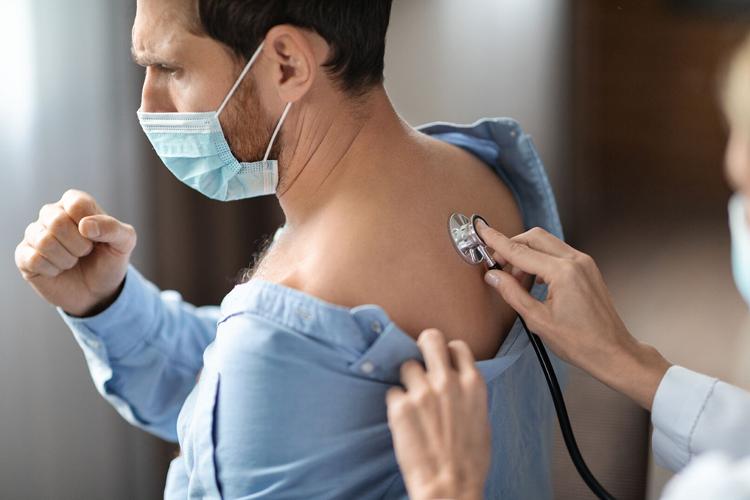
Breath is life. To stay alive, we need oxygen, delivered via air, inhaled through the lungs. When lung function is compromised, so is the quality of our life.
Pulmonology is a medical specialty of internal medicine, which focuses on the respiratory system, from the trachea to the lungs. Pulmonologists, having received their medical degree, complete their internal medicine residency, followed by several years as a fellow, focused on pulmonology, which typically includes critical care.
“A pulmonologist typically evaluates and treats asthma, chronic obstructive lung disease (COPD), emphysema, lung cancer, lung infections (including tuberculosis), pulmonary hypertension, and cystic fibrosis,” says Dr. Lorraine Coli, MD, a pulmonologist who joined Montage Medical Group in March. They also treat “a group of disorders that cause progressive scarring of lung tissue, and occupational lung diseases, those caused by inhaling irritants on the job.”
Dr. Coli who completed her pulmonology internship at the Mount Sinai School of Medicine Elmhurst Hospital, her residency in internal medicine at Montefiore New Rochelle Hospital, an affiliate of Albert Einstein School of Medicine, and her pulmonary fellowship at the State University of New York Buffalo, hails from 34 years’ experience in pulmonary and critical care at a nonprofit medical group and Level 1 trauma center in Southern California.
Dr. Coli is one of four pulmonologists to join Montage Medical Group during the past year, in response to a demonstrated need for additional pulmonary care among the community.
“We all have various backgrounds and knowledge in this field, which is important for a community trying to address a huge need for pulmonary care,” says Dr. Antonette Ajayi, MD, MPH. “We have patients with known underlying lung disease, asthma, COPD, and issues not yet diagnosed but indicated by shortness of breath or a chronic cough, which warrant evaluation by a pulmonologist. Sometimes, less-urgent symptoms, such as a cough, can be managed by a primary care physician. But, if interventions haven’t helped, it’s time to explore treatment by a pulmonologist.”
Born in Fresno and raised in her family’s native Nigeria before returning to Fresno just prior to high school, Dr. Ajayi, who graduated from the David Geffen School of Medicine at UCLA PRIME Program, was chief resident during her internal medicine residency at Kaiser Permanente Medical Center in Santa Clara, before completing her fellowship in pulmonary critical care medicine at Stanford Medical Center.
“I actually went to UC Santa Cruz for my undergraduate degree in marine biology,” says Dr. Ajayi. “I wanted to study something interesting and fun while satisfying my prerequisites for medical school. I don’t like scuba diving or being cold, but I find the ocean fascinating.”
During medical school at the Icahn School of Medicine at Mount Sinai in New York, Dr. Yosuf Subat, MD, MPH, was amazed by the dynamic of learning something from a book and then using that material to help people get well.
“I first fell in love with working in the ICU,” he says. “Once I understood how critical care and pulmonary medicine are connected, I knew I’d found my purpose. Having played basketball in high school, I love the teamwork required in the ICU and the idea of an interdisciplinary team working together for a common goal on behalf of our patients.”
Dr. Subat also appreciates the diversity of his work. One week, he says, he’s in the ICU, dealing with intensive, high-stakes situations that require precise focus and quick decisions. The following week, he will sit down with a patient to make decisions together, building a collaborative patient-physician relationship.
Dr. Jaya Prakash Sugunaraj, MD, who also pairs pulmonology with critical care in his practice, has found his work particularly important during the pandemic.
“Lung health has become a primary focus,” he says, “more than any other time. We are performing a lot of specialized procedures, including a lung function test, CAT scans, and endobronchial ultrasounds, as well as bronchoscopy. Science is moving forward, and we see ourselves at the forefront of the disease to diagnose and get patients into the right treatment and have a better outcome.”
Dr. Sugunaraj attended medical school at Madras Medical College, Chennai, and completed his residency at the All-India Institute of Medical Sciences in New Delhi and Griffin Hospital/Yale University in Connecticut. He completed his fellowshipin Pulmonary and Critical Care Medicine at Geisinger, where he served as an Associate Physician in Pulmonary and Critical Care Medicine. The former Assistant Professor at Temple University joined Montage Medical Group this fall.
“I find it instantly rewarding,” he says, “when helping someone struggling to breathe comes back a totally different, more vibrant person.” People who feel they may need pulmonary care are encouraged to seek a referral from their primary care physician. “Patients with a referral can have an appointment the next day, “ says Dr. Lorraine Coli. “This is what I do all week. I have plenty of room for patients, and I welcome them.”
Meet Montage Medical Group pulmonologists at montagemedicalgroup.org/pulmonology.

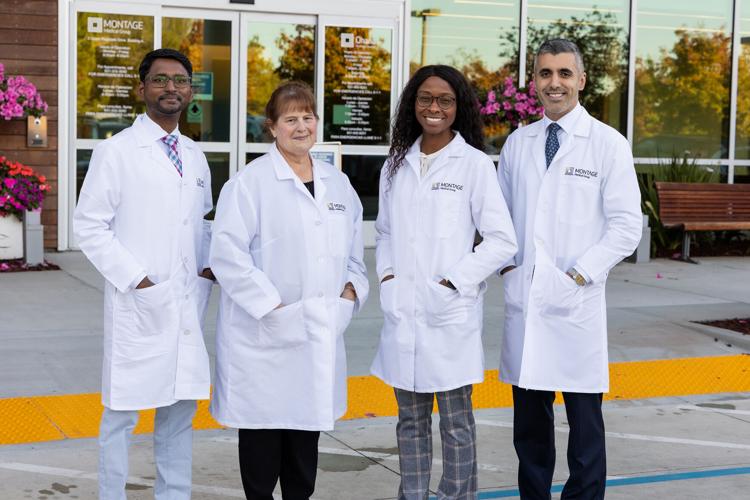
(from left): Dr. Jaya Prakash Sugunaraj, Dr. Lorraine Marie Coli, Dr. Antonette Aderemi Ajayi, and Dr. Yosuf Walid Subat
(0) comments
Welcome to the discussion.
Log In
Keep it Clean. Please avoid obscene, vulgar, lewd, racist or sexually-oriented language.
PLEASE TURN OFF YOUR CAPS LOCK.
Don't Threaten. Threats of harming another person will not be tolerated.
Be Truthful. Don't knowingly lie about anyone or anything.
Be Nice. No racism, sexism or any sort of -ism that is degrading to another person.
Be Proactive. Use the 'Report' link on each comment to let us know of abusive posts.
Share with Us. We'd love to hear eyewitness accounts, the history behind an article.