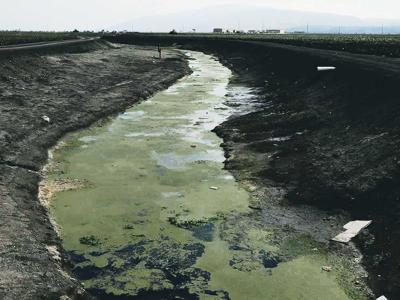

It’s one thing for regulators to monitor clean water rules for point source pollution – think of an outfall pipe from a factory. It’s another thing to regulate nonpoint source pollution from hundreds of thousands of acres of farmland.
Even California’s water quality law, the Porter-Cologne Act, recognizes the challenge. A 2004 addendum about nonpoint source pollution put it this way: “Current land use management practices that have resulted in nonpoint source pollution have a long and complicated physical, economic and political history… Therefore, it is expected that it will take a significant amount of time for the [regional water boards] to approve or endorse nonpoint source control implementation programs.”
That time, according to the Court of Appeal for California’s Third District, has come. A Sept. 18 decision affirms a ruling that the state’s effort to regulate agricultural water pollution on the Central Coast was too weak. “The decision was a huge win that we were hoping for,” says Monterey Coastkeeper Executive Director Steve Shimek.
In 2013, the Central Coast Regional Water Quality Control Board approved regulations aimed at minimizing agricultural water pollution. Agricultural groups saw those rules as too tough; environmental groups, like Coastkeeper, viewed them as not tough enough. Both sides appealed to the State Water Resources Control Board, which upheld the rules. Coastkeeper, along with other environmental groups, then sued the state water board; the group won in Sacramento County Superior Court in 2015. The state board, joined by ag groups, appealed. (No word on whether they’ll appeal again to the state Supreme Court.)
The appellate decision sides with the state board on some technicalities – what Shimek calls “little, niggling things that just don’t matter” – but it upholds the lower court’s decision that the regulations are too weak. “Rather than establishing time schedules and milestones, it requires only vague and indefinite improvement – ‘a conscientious effort,’” the decision states.
Tim Moran, a spokesperson for the state water board, takes those technicalities more seriously, and says the board is happy with the appellate decision.
"The appellate decision upholds key provisions and the fundamental architecture of the board’s order," Moran writes by email.
He adds that the state is already incorporating changes.
The regional water board is at work on the next set of five-year regulations, and is set to hear two days of public comment on it at a board meeting in Watsonville on Sept. 20-21. Shimek expects this ruling means the next batch of regulations, scheduled to roll out in March 2020, will be much stricter.
"With regard to the Central Coast Board proceedings underway, those proceedings are following the modified approach to water quality requirements set out by the State Water Board," Moran adds.
Shimek hopes not only that the court-approved higher bar catches on in the Central Coast, but elsewhere in the state.
“We are out to improve the agriculture industry statewide, and nationwide,” Shimek says. “We are out to make waves, not ripples.”




(1) comment
This is not a win for MP drinking water consumers. It just means more Ag Industry pollutants will be fed into Pure Water Monterey facility for us MP ratepayers to drink and have our health damaged.
Welcome to the discussion.
Log In
Keep it Clean. Please avoid obscene, vulgar, lewd, racist or sexually-oriented language.
PLEASE TURN OFF YOUR CAPS LOCK.
Don't Threaten. Threats of harming another person will not be tolerated.
Be Truthful. Don't knowingly lie about anyone or anything.
Be Nice. No racism, sexism or any sort of -ism that is degrading to another person.
Be Proactive. Use the 'Report' link on each comment to let us know of abusive posts.
Share with Us. We'd love to hear eyewitness accounts, the history behind an article.