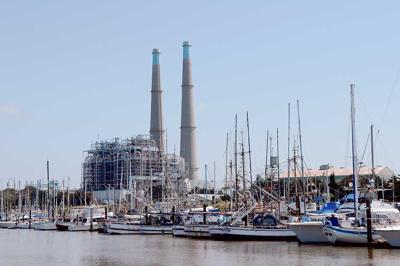
For nearly a half century, the 500-foot twin stacks rising from the Moss Landing power plant helped churn out power to millions of homes and businesses, while serving as beacons to travelers by land and by sea. Dynegy Inc. pulled the plug on the stacks on Dec. 31. They’ll no longer generate power, but will stand for now – along with nearly $1 million in fees a year paid to the Monterey Bay Air Resources District.
Without those fees from Dynegy, the air district would probably have to lay off staff and raise fees for smaller pollution emitters in the region to make up the difference, says Richard Stedman, air pollution control officer for the district.
Plant Manager Rex Lewis confirms that Dynegy Inc. shut down the “vintage” stacks, known as units 6 and 7, because their older technology made them inefficient. And although shutting down the outdated stacks would entitle the company to request lower fees from the air district, there are currently no plans to do so – despite a squabble in 2013 in which Dynegy claimed it had overpaid $9.5 million.
The plant continues to produce power through its smaller and more efficient units 1 and 2, which came online in 2002, and still remain a “very large source” of emissions in the district, according to Stedman.
Stedman says if the company did formally ask for a fee restructuring, it could pay around $400,000 less than it does now. About a third of the air district’s $6.5 million annual budget is for “stationary source” polluters, like the Moss Landing plant, rather than mobile sources like cars, planes and boats.
When energy companies retain permits for inoperative equipment, it sometimes means they are positioning themselves for a sale, Stedman says. Lewis demurs when asked about a possible sale.
“My understanding is that any power plant is a sale product,” Lewis says. For the foreseeable future, Lewis adds, “We’re going to continue to own and operate the plant.”
That includes maintaining the two stacks and inspecting them every two years to make sure they are structurally sound, he says.
Stedman says if Dynegy keeps its current permits for units 6 and 7 in place the company avoids triggering a review by the air district and face requirements to meet newer equipment specifications, which in turn could mean an outlay of cash for more expensive cleaner-burning equipment, Stedman says.
In their heydey, units 6 and 7 were each capable of generating 750 megawatts of power, enough to power 1.1 million homes. But because of their aging technology, the stacks were being used less and less: In 2016 Lewis estimates they were only running about 3 percent of the time.
There are currently no plans to dismantle the stacks, which is good news for boaters who use them for navigation into Moss Landing Harbor.



(0) comments
Welcome to the discussion.
Log In
Keep it Clean. Please avoid obscene, vulgar, lewd, racist or sexually-oriented language.
PLEASE TURN OFF YOUR CAPS LOCK.
Don't Threaten. Threats of harming another person will not be tolerated.
Be Truthful. Don't knowingly lie about anyone or anything.
Be Nice. No racism, sexism or any sort of -ism that is degrading to another person.
Be Proactive. Use the 'Report' link on each comment to let us know of abusive posts.
Share with Us. We'd love to hear eyewitness accounts, the history behind an article.