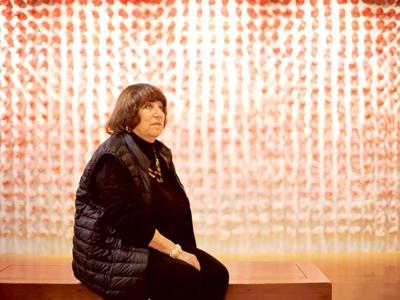

About five years ago, Gail Enns, an independent curator and former gallery owner (Green Chalk Contemporary, Anton Gallery), said she happened on a gathering of hundreds of people quilting in the Pacific Grove Community Center. Only one of them was a man.
“I’m a sewer, knitter, quilter and crafter,” she says. “I did my children’s clothes.”
A new show of nine women artists that she’s curated at Monterey Museum of Art, called The New Domestics: Finding Beauty in the Mundane, reflects her fascination with the so-called domestic arts – sewing, needlepoint, embroidery, cross-stitch – the type of handiwork relegated as “women’s work.” She recalls Judy Chicago’s 1970s art installation The Dinner Party and Eva Hesse’s 1992 retrospective at the Hirshhorn in D.C. as both reimagining, retooling and reclaiming domestic arts into vehicles of critical artistic expression.
Enns has curated local shows – NOISE in 2008 and Awakening in 2017 – that contained strong (and progressive) political content, and says although the women in The New Domestics refrain from overt agendas, they might evoke political thought. For several years she’s looked at the work of more than 75 California artists – in their studios, in galleries, and online – to assemble the group for this show, which fits into the museum’s 2018 Year of the Woman theme.
Susan Abbott Martin has four related works in the show. “Women’s Work: Days of the Week” consists of small white canvases embroidered in blue with daily domestic chores – grocery shopping on Friday, cleaning on Wednesday – next to collages of color ads of 1950s housewives ecstatically happy to be doing such.
“Women, for hours, would do back-stitching after dinner,” Enns says. “It was like a meditation.”
Victoria May’s work is bold, with an undercurrent of tension, and slippery to grasp. She has an installation of cut-up inner tubes stitched together like crumpled black leather jackets, and installed on the wall. The shiny blackness lures in the eyes, but even up close it eludes elucidation in favor of pure sensation – dread or confusion – and together are called “Fetish Installation.”
Enns admires the youthful attitudes in the cut-up collage works of the Temple sisters – Holly and Ashlee. They depict young women beaming with energy and verve, abutted by strips of paper, ledgers, notes, schematics and wallpaper that are seemingly trying to enclose the women, to no avail. Mitra Fabian reworks tiny, shiny capacitors and transistors into patterns that neatly radiate or order themselves into skeletal shapes. In the catalog’s forward, Patrick Frank writes that she takes on the Silicon Valley boys club with a Situationist-like appropriation.
The show is billed as a rediscovery of domestic arts, crafting and handiwork. But that stuff has never completely left the cultural landscape. The DIY and Lo-Fi movements kicked up a flurry of knitting and sewing circles a few years ago, and maker workshops have been popping up more and more places.
Patrick Frank writes, “The title [of the exhibit] might suggest that curator Gail Enns has gathered some artists who want to retreat to the home front in the face of the cacophony outside.”
But it seems like that cacophony outside is where the frontlines of the feminist movement is now – not in the home but in the workplace – with women smashing against glass ceilings, locked doors and fixed stereotypes, as journalists covering men’s sports, as combat soldiers, as religious clerics, as bosses. Is retreat really the way to respond to #MeToo, Time’s Up, or women political candidates, or regressives like Trump and his ilk?
Frank further suggests that the trafficking in the domestic arts is a ploy, that the artists destroy the material or repurpose it, as an endrun to civil disobedience.
Enns writes in the catalog: “[This] work is also often jarring, arousing feelings of injustice, anger, grief and hope.”
The domestic arts (and politics) theme leaves the show for brief periods.
Katherine Sherwood has a number of paintings that look like unfinished floral still lifes. Arranged among the blooming flowers in vases are MRI images of her brain, reminders of the cerebral hemorrhage that intruded into the picture and disrupted her functioning. And Judy Shintani cuts up kimonos and presents the pieces in a sacrificial bowl in front of the tattered remains of the garments, making comment on tradition and custom, but in the mode of textile art.
But the themes come back with a grand finale of Lisa Solomon’s Japanese homage “Senninbari [1000 stitch knot belt]” that’s like a summary of the show’s message of looking closer at small or mundane actions, of those small, mundane actions adding up. And if you want to see political allusions in that, it’s there.
“Anything done once can be done 1,000 times,” Enns says. It sounds like the type of ethic behind anachronistic pastimes like crafting and sewing, and also like the way big, vibrant shows of force, like the Women’s March or political elections, gather momentum.
THE NEW DOMESTICS: FINDING BEAUTY IN THE MUNDANEis viewable 11am-5pm daily (closed Wednesdays) at 559 Pacific St., Monterey. $10/adult; free/student, active military, minors, museum member. 372-5477, montereyart.org
(0) comments
Welcome to the discussion.
Log In
Keep it Clean. Please avoid obscene, vulgar, lewd, racist or sexually-oriented language.
PLEASE TURN OFF YOUR CAPS LOCK.
Don't Threaten. Threats of harming another person will not be tolerated.
Be Truthful. Don't knowingly lie about anyone or anything.
Be Nice. No racism, sexism or any sort of -ism that is degrading to another person.
Be Proactive. Use the 'Report' link on each comment to let us know of abusive posts.
Share with Us. We'd love to hear eyewitness accounts, the history behind an article.