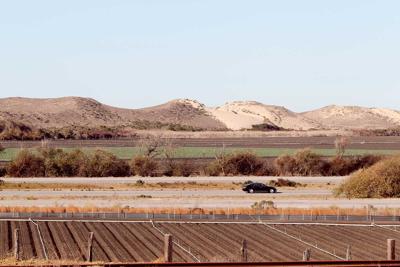

David Schmalz here, wrestling with a conundrum: Seawater intrusion is advancing in the northern Salinas Valley—heading toward Salinas from the coast—which has forced growers to drill deeper wells, but that’s only made the problem worse.
Why does that matter? The drinking water supplies of more than 150,000 people, and the viability of highly productive ag land, hang in the balance.
Last Wednesday, Dec. 4, county staff presented the Board of Supervisors a report about the state of the groundwater situation in the Salinas Valley Basin. The report is not new—it was published in 2023, but it was started in 2015.
None of its findings are surprising to anyone paying attention: Groundwater levels continue to fall, though the lettuce, strawberries and artichokes are still getting all the water they need to thrive.
But seawater intrusion is a slow-moving, potential train wreck that could impact the water supplies of tens of thousands of county residents, both in the Salinas Valley and Marina.
Groundwater is a finite resource. As long as overpumping remains profitable, and possible—even though it might have disastrous impacts—it will persist.
Armstrong Ranch—north of Marina—for example, was pasture land for decades, but after Valle Del Sol Properties LLC bought the ranch’s 1,784 acres for $81.5 million in November 2017, it has since been turned into ag fields irrigated by water from the Deep Aquifer, which is around 900-feet underground and is not replenishing. The county subsequently approved the new wells into the Deep Aquifer on that land—the permits were ministerial, there was no environmental review.
And this problem has all played out in plain sight, if in slow motion.
The Supervisors took no notable action when hearing the information—they didn’t have the option to—but the discussion had the vibe of, “more of the same,” which is kicking the can down the road.
The study was undertaken due to litigation from the Salinas Valley Water Coalition, Landwatch Monterey County and the Open Monterey Project initiated regarding the county’s 2010 general plan—producing the study was part of the settlement. The general plan, as approved, requires all discretionary projects to have a sustainable water supply.
And if seawater intrusion continues to advance, as it has since it began several decades ago, the supervisors are empowered to do something about it.
Michael DeLapa, Landwatch’s executive director, sent a letter to the board in advance of the meeting, arguing that implementing pumping allocations in the 180-foot and 400-foot aquifers is the best course of action, so as to better understand what the demands are going forward.
I caught up with Piret Harmon, the Salinas Valley Basin Groundwater Sustainability Agency’s general manager, about the state of play. In her view, the 2023 study is already outdated, and she says SVBGSA has already collected a lot of data that paints a more complex picture.
So, the agency is working on feasibility plans for various infrastructure projects that would help bolster the water supply, but it’s not yet clear who would pay, or how much it would cost.
But the thing she said to me that stopped me in my tracks is this—she says that in SVBGSA’s modeling, even if all the pumping stopped tomorrow, seawater intrusion would still continue because the groundwater levels are so low.
It’s unclear how this will all play out in the coming years, but if the past is predictive, I don’t expect any elected officials to stand up to ag interests, which account for about 90-percent of the basin’s groundwater pumping every year.
As for the thousands of residents also relying on that water, they can eat cake.


(1) comment
While Valle del Sol is making money for themselves, the long-term prospect for the existing growers and residents diminishes. I spoke with Jack Armstrong, at his residence, about his ranch and its prospective uses, many years prior to that sale. He indicated that it was essentially out of his hands and in those of his kids, They apparently decided to rid themselves of their inherited ranch for a quick-money sale. Money talks. I would suggest that a water-injection system be installed, similar in scope to that of Monterey One Water, to generate a barrior between the sea water and the water from the Salinas Valley, to prevent further intrusion. This will require more infrastructure to capture more of the winter run-off. Who's to pay? Those who draw from near the sea.
Welcome to the discussion.
Log In
Keep it Clean. Please avoid obscene, vulgar, lewd, racist or sexually-oriented language.
PLEASE TURN OFF YOUR CAPS LOCK.
Don't Threaten. Threats of harming another person will not be tolerated.
Be Truthful. Don't knowingly lie about anyone or anything.
Be Nice. No racism, sexism or any sort of -ism that is degrading to another person.
Be Proactive. Use the 'Report' link on each comment to let us know of abusive posts.
Share with Us. We'd love to hear eyewitness accounts, the history behind an article.