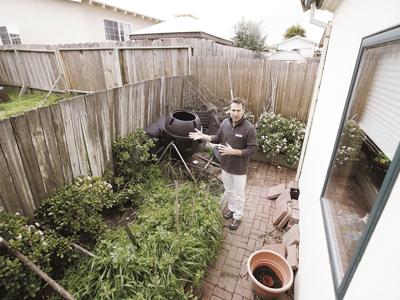

Officials in nearly every city are looking at ways to minimize permitting headaches for builders, but when it comes to water savings, one man is calling on the City of Monterey to offer an even faster fast track. Scott McKenzie is operations manager for Greenwise Water and Landscapes, which provides native flora fed by captured rainwater and graywater, and which has been petitioning the city to change its code.
“I would like to see very loose regulation around water conservation construction,” McKenzie says.
McKenzie has called on Monterey to do what the state did with solar in 2014 with the Solar Rights Act, which allowed contractors and individuals to bypass the planning review process. Eliminating the review stage saves customers in Monterey $199 in fees on solar projects, says Kimberly Cole, a city planner. The fast track also takes away a neighbor’s right to contest a solar project as a property-value-degrading eyesore.
On a typical $3,000 rainwater capture or graywater recapture system, city permitting fees add up to $450, or 15 percent of total project costs, McKenzie says. “I’m not against the city, I’m for the city,” he adds. “But I don’t want Monterey to ride the backs of business, especially one like ours that provides a public service.”
To help incentivize rainwater capture, the Monterey Peninsula Water Management District provide rebates to consumers who install rainwater systems. In 2015, MPWMD gave rebates to 70 people to the tune of $70,000 total, says Stephanie Locke, the agency’s water demand manager.
Rebates aside, McKenzie’s ultimate goal is for the city to completely eliminate permitting fees for water-saving projects – going far beyond the solar fast track. He would like the city to simply certify companies, then let them develop water systems with occasional random inspections to keep them honest.
But the only company to certify would be Greenwise – currently the only gray-water game in town, according to both Cole and McKenzie.
Later this year, the Monterey Planning Commission will consider changing the zoning code that requires a 5-foot setback from property lines, which often forces rain and graywater tanks to be located awkwardly in the middle of the yard instead of against a fence, Cole says. But there are currently no plans to address the review process.
“Every contractor in the city knows there’s a process for building,” Cole says. “[McKenzie] doesn’t agree he has to pay; he wants to be the exception.”


(0) comments
Welcome to the discussion.
Log In
Keep it Clean. Please avoid obscene, vulgar, lewd, racist or sexually-oriented language.
PLEASE TURN OFF YOUR CAPS LOCK.
Don't Threaten. Threats of harming another person will not be tolerated.
Be Truthful. Don't knowingly lie about anyone or anything.
Be Nice. No racism, sexism or any sort of -ism that is degrading to another person.
Be Proactive. Use the 'Report' link on each comment to let us know of abusive posts.
Share with Us. We'd love to hear eyewitness accounts, the history behind an article.