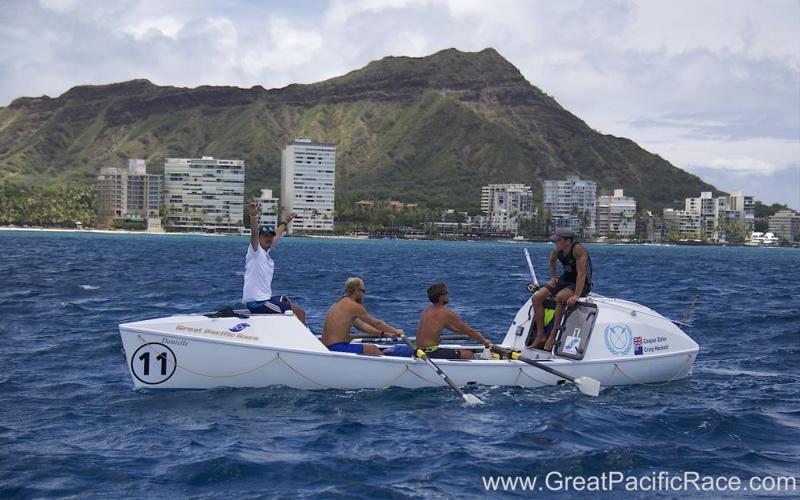
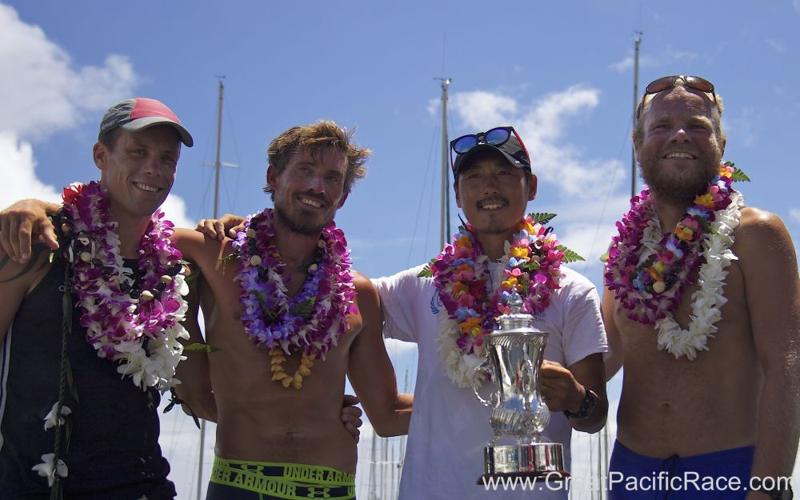

After 43 days, 5 hours and 30 minutes—and, oh, 2,400 miles of wide open ocean—team Uniting Nations finally crossed the “finish line” of the Great Pacific Race.
It was a finish with many firsts.
The first four-person team to accomplish this feat earned a spot in Guinness World Records.
Craig Hackett, 31, is the first New Zealand man to row the Pacific.
Junho Choi, 33, is the first ever Korean to row any ocean.
Of their accomplishment, race director Chris Martin said, “Seeing this record setting team from all corners of the globe arrive in Hawaii, after spending more than a month racing from Monterey in the Great Pacific Race is testament to the power of the human spirit. They have battled against their peers in other boats, the adverse weather and overcome broken equipment to win the biggest, baddest human endurance race on the planet.”
Other teams also offered their congratulations.
“A big bravo to Uniting Nations Row for their splendid route and the amazing aventure they must have lived. Their very first swallow of piña colada is very much in our thought,” said CC4 Pacific, who is still a ways from Hawaii.
Victory, or at least solid ground, must be sweet. It was also hard earned for this crew, which encountered its fair share of struggles.
About eight days after leaving the California Coast, their electric watermaker stopped working.
The team had to resort to a hand pump desalinator to turn sea water into drinking water for the rest of their voyage.
Next, it was seats that stopped moving, which is a lot worse than it sounds when half of your time, sleeping or awake, is spent on a rowing seat meant to shift with each stroke.
“After many repairs over the past few weeks, the bow seat had finally broken and was irreparable,” said crew member Casper Zafer in a day 32 race report. “This means that one rower can only use their torso and arms to power the boat instead of using their legs as well. This not only makes maintaining timing between the two rowers difficult, but it also increases the chance of the oars clashing and breaking. It also significantly reduces the amount of power that can be applied by one of the rowers, meaning that the boat will go slower.”
For a time, they also lost satellite communication. That proved a temporary result of the phone not having enough minutes, not it being broken, as they later learned.
But just the basic living situation is grueling enough.
“There is no privacy. There is no escape,” a day 15 race report remarks.
If you thought your college dorm situation was bad, visualize sharing that same closet with not one, but three other people.
“Floor space [in the cabin] is about the size of a one man tent with 20 days of food,” wrote the girls of the rowboat Boatylicious on their blog.
And the bathroom situation…
As we learn from a very detailed Battleborn boys bathroom blog post, crew members must become pretty comfy with the bucket as the primary plumbing system.
Barry Hayes writes, “So, yesterday Dan had a ‘number 2′ in the bucket, but got very excited about it. Like an excited toddler that has used the potty for the first time, he felt he needed to alert me to what he had done. What he had done can only be described as ‘The Titanic’...Oddly this made me get quite excited for my next ‘passing’...alas, as I peered into the orange bucket, there sat the most average of poos—nothing at all to write home about. Not even enough to show to Dan.”
Uniting Nations also got to know eachother quite intimately.
According to a Day 17 race report, some Uniting Nations crew members (not named) took to life au naturale.
“While this [improved] their ability to row as they are less restricted, other crew members [found] this this system to not be the greatest visually.”
But maybe it was the secret to success.
The finish line of the Great Pacific Race extends 3 nautical miles due south from the lighthouse on Diamond Head, O’ahu, where the crews are met by a support vessel which takes an official finish time and offers the crew an optional tow to the marina at Waikiki, where the boat docks.
The crews are then put through an entry procedure with customs and reunited with family and friends—who are encouraged to bring “at least one fresh floral lei,” as per local custom.
When Chris Martin finished his row from Japan to San Francisco, he said the thing he most desperately wanted to do is walk more than a few steps in a row.
Uniting Nations, whose members hail from four different countries and met just a month before shoving off on the tiny boat, is not the only team to cry “Land ho!”
Elsa Hammond, the only solo rower still in the competition, has decided to point her bow towards a new tropical destination: Mexico.
With her exact docking location still not confirmed, she is still close enough to the coast to sight land.
“When I woke up this morning I could see a low dark smudge on the horizon, which looked like a cloud,” she said on Tuesday. “My eyes can’t help but be drawn to the lumpy shape in the distance.”
Check out further coverage of the self-proclaimed biggest, baddest human endurance challenge on the planet, including rashes and cheese losses, rescues, and the man behind the mission, Chris Martin.
Also, keep up to date on Hammond and the remaining crews’ progress on GPR’s race tracker, updated every 30 minutes.
The next team expected to finish is Battleborn.
So the race continues.


(0) comments
Welcome to the discussion.
Log In
Keep it Clean. Please avoid obscene, vulgar, lewd, racist or sexually-oriented language.
PLEASE TURN OFF YOUR CAPS LOCK.
Don't Threaten. Threats of harming another person will not be tolerated.
Be Truthful. Don't knowingly lie about anyone or anything.
Be Nice. No racism, sexism or any sort of -ism that is degrading to another person.
Be Proactive. Use the 'Report' link on each comment to let us know of abusive posts.
Share with Us. We'd love to hear eyewitness accounts, the history behind an article.