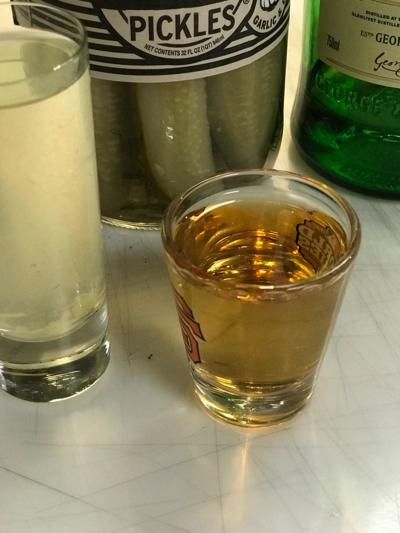

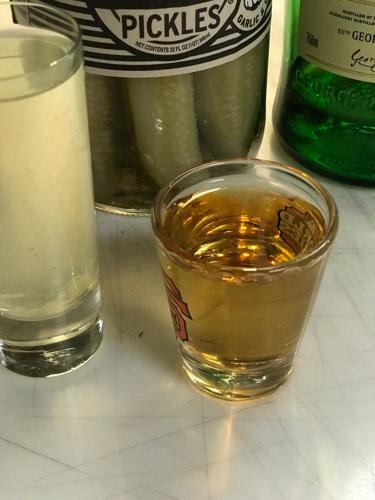
The first time Jose Niño heard a customer order something called a pickleback, the Lalla Oceanside Grill bartender stood fixed for a moment, a blank look on his face. It sounded like some sort of dare. Perhaps one of his guests lost a bet.
A similar incredulous gaze probably crossed the face of Reggie Cunningham, the Brooklyn bartender largely credited with giving the double-shot combination its name. In fact, most people share the same dubious reaction the first time. Why, oh why would anyone crave whiskey with a chaser of pickle juice?
“It’s not bad, if you have bad bourbon,” observes Rory Filbin, a manager at Tarpy’s Roadhouse.
Following a sip of whiskey with a shot of brine does a little more than wash the scorched savor of the spirit from your palate. It leaves a faint residue of sweetness that picks up on mellow, caramel notes in the whiskey and allows it to linger. But—yeah—for the most part it just wipes away any traces of whiskey, perhaps smoothing over the harsh bite of cheap alcohol.
So how did it become a hipster favorite? Well, no one is quite certain.
As the story goes, a southern woman with a raspy, cigarette-and-whiskey croak to her voice, strode into Cunningham’s bar and asked for the combination. For some reason he tried it, as well, chasing a pour of Old Crow. Finding it not at all as awful as expected, he dubbed it the “pickleback” and began urging it on the bar’s regulars.
That was in 2006. By 2010, the pickleback had gained a following in hipster hangs nationwide. Major distillers, like Jameson’s, began endorsing the combination as a way to sell more whiskey. “Mixologists” cured pickles and then okra, kimchi, jalapeños and other vegetal matter (someone probably tried kale at some point) specifically for their bespoke versions of the drink. At Tarpy’s they garnished with watermelon for an even cleaner, sweeter finish.
And then demand for the pickleback settled. Tarpy’s wisely dropped it from the cocktail list. At Lalla, Niño says, “It’s not a usual thing anymore, but I have served it.”
Yet the combination never went away.
Travel outside of Monterey to, say, Portland, Oregon, and you might still find bars with their own pickleback menus pairing the remains of brined berries, fruits, herbs or whatever with specific whiskeys. Some places have extended the concept to include rum, gin and even aquavit.
When a customer at Brophy’s Tavern in Carmel called for a pickleback, bartender Xavier Plasencia searched in vain for dill pickle juice.
“I had to serve them cornichon juice,” he says with a laugh. “Only in Carmel.”
To answer this week’s Burning Question, it would be accurate to blame the young and hip and their willingness to sample new things. It would also be true to say that it helped ease novice drinkers into whiskey and other robust brown spirits.
After a few goes with fellow Burning Question crewmembers, we would add that the combination is not as unsettling as you might think. Oh—and it works as a balm for those cheap well spirits, saving bar patrons a bit of cash. And we could stand on any of those answers. Yet the rise of the pickleback should not be so surprising.
Despite the apparent strangeness of the phenomenon, there is some justification for the drink. In the past, sauerkraut juice was served in restaurants alongside more normal fixtures. In hot weather, a tart and sweet chaser comes across as refreshing. A native of El Paso, Plasencia says he was already familiar with the pickleback, even before it received a big city stamp of approval.
“It’s definitely something from the south,” he says.
And when we follow the lead of southern states, things always work out for the best, right?


(0) comments
Welcome to the discussion.
Log In
Keep it Clean. Please avoid obscene, vulgar, lewd, racist or sexually-oriented language.
PLEASE TURN OFF YOUR CAPS LOCK.
Don't Threaten. Threats of harming another person will not be tolerated.
Be Truthful. Don't knowingly lie about anyone or anything.
Be Nice. No racism, sexism or any sort of -ism that is degrading to another person.
Be Proactive. Use the 'Report' link on each comment to let us know of abusive posts.
Share with Us. We'd love to hear eyewitness accounts, the history behind an article.